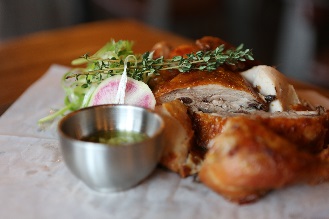
The short answer: after processing, chicken has to be cooled quickly. Water-chilled chicken is cooled in a bath of cold water and absorbs some of it: typically 8 to 12% of its weight, of which Canada allows up to 8% to stay in a chicken under 2.3 kg. Air-chilled chicken is cooled by cold air instead, and to carry that label it must gain no water at all. The result is meat that tastes more like chicken, browns better, and where you pay for chicken, not water.
How chicken is chilled
Food safety rules require every bird to be cooled quickly after processing, to keep bacteria from growing. There are two ways to do it:
- Water chilling: the birds move through large tanks of ice-cold water. It is fast and inexpensive, and it is the most common method in North America.
- Air chilling: each bird hangs on a line and travels through chambers of cold, circulating air, often for two hours or more. It is slower and takes more space, which is why air-chilled chicken usually costs a little more.
What Canada's rules say about water
A chicken in a water bath can take up 8 to 12% of its weight in water. The Canadian Food Inspection Agency (CFIA) limits how much of that it may keep when it is sold:
| Product | Retained water allowed |
|---|---|
| Whole chicken under 2.3 kg, water chilled | up to 8% |
| Whole chicken 2.3 kg and over, water chilled | up to 6% |
| Labelled "air chilled" | none: the average weight gain must be 0.0% |
A processor that wants to print "air chilled" or "no water added" on the label has to prove it, with written procedures and test results reviewed by the CFIA veterinarian at the plant.
Air-chilled vs water-chilled: the differences you'll notice
- Flavour: with no absorbed water, the meat's own flavour isn't diluted.
- Texture: air-chilled meat is firmer; water-chilled meat can be softer and a little spongy.
- Cooking: less water means less spitting in the pan, less liquid in the roasting tray, and crispier, browner skin.
- Shelf life: in our experience, air-chilled chicken kept longer. Without a soak, the skin stays intact and acts as a natural barrier, keeping water, and whatever the water carries, out of the meat.
- Price per bite: air-chilled chicken costs a little more per kilogram, but none of that weight is water.
- Nutrition and safety: both are safe when handled and cooked properly. Cook either to Health Canada's temperatures: 74°C (165°F) for pieces, 82°C (180°F) for a whole bird.
Is air-chilled the same as organic?
No. Air chilling describes how the chicken was cooled at the plant; organic and raised without antibiotics describe how the bird was raised. A chicken can be any combination of them, so read each claim on the label on its own.
How to tell which you're buying
Look for the words "air chilled" on the package. Because the claim has to be proven to the CFIA, it only appears on chicken that really is. If the label says nothing, assume the chicken was water chilled. At a butcher's counter or a farm stand, ask: a local butcher will know how their chicken was processed. The Simcoe County Farm Fresh and York Farm Fresh guides list farms and farm stores near Bradford.
Cericola Farms and air chilling
All of Cericola Farms' chicken was air chilled. We put in the extra time and space so that our grain-fed organic chicken, animal by-product free chicken and chicken raised without antibiotics kept their natural flavour and texture all the way to the store. Those products are no longer available: Cericola Farms' plants have been part of Maple Leaf Foods since 2018 and 2021. Today, look for "air chilled" on the label, or ask your local butcher.